
One of my favourite destinations in India is the Ramanathaswamy temple in Rameshwaram, Tamil Nadu. The lively town of Rameshwaram exemplifies India’s rich heritage in history, spirituality, and architecture. Located on Pamban Island, the temple is accessible via the well-known Pamban Bridge, which spans just over 2 km.
This narrow waterway separates India from Sri Lanka, and at certain points on Pamban Island, the Sri Lankan coast is visible. As per Hindu legend, Lord Rama constructed a stone bridge linking Rameshwaram and Sri Lanka.
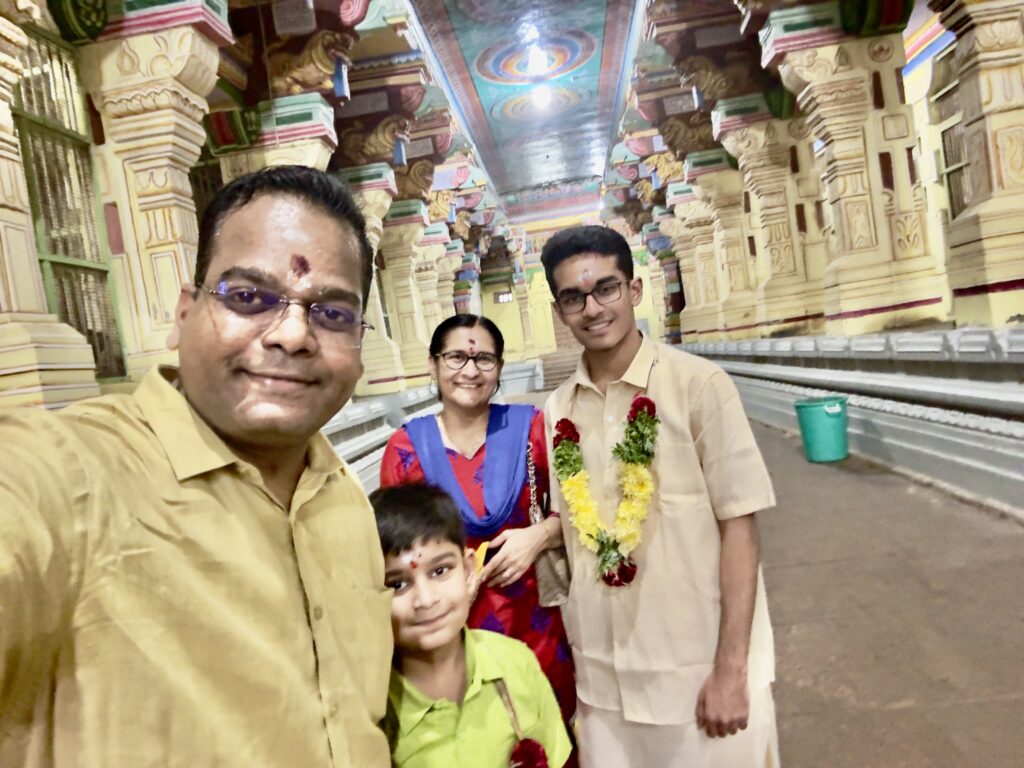
Rameshwaram is renowned as one of Hinduism’s holiest sites and has at times been called the Varanasi of southern India for its spiritual significance. The Ramanathaswamy temple can only be described as spectacular. It spreads over 15 acres and is home to the world’s longest temple corridor, with 1212 symmetrical pillars in the outer corridor. The temple’s layout bears witness to the intricate Dravidian style. The first corridor houses the main deity and dates to the 12th century. Granite is not available locally in Rameshwaram and must have been brought in from elsewhere in Tamil Nadu. The carvings and paintings on the pillars are breathtaking, and it would not have been difficult to spend a full day admiring them. The incredible thing is that if you look at the pillars from one end to the other, they all converge to form a single dot. Furthermore, each pillar tells a story through intricate carvings of deities, animals, and scenes from Hindu epics.
A notable feature of the Ramanathaswamy temple is its 22 Theerthams, or sacred water wells. Legend has it that these wells were created using Lord Rama’s arrows. Lord Rama then asked for water from various pilgrimage sites and poured it into the wells, transforming them into revered Theerthams.
Before visiting the temple, devotees take a full bath, including washing their hair, to appear in their purest and cleanest state. Each Theertham water is believed to have unique healing qualities and to purify the soul in specific ways, emphasising the connection between mind, body, and spirit. Each Theertham water varies in temperature and salinity, despite being located close to one another. A key ritual involves pouring a bucket of holy water from each well over the head, symbolising purification and indicating that the devotee is ready to approach the divine in the temple.
I can attest to the power of the purification ritual. I have been there twice in the past six months, and the experience was the same both times. No matter how tired, weighed down or stressed I may be before visiting Rameshwaram, as soon as I enter the sacred space, peace and serenity settle within me. The feelings of exhaustion and stress begin to lift as soon as the water from the first Theertham touches my head. Whatever load I may be carrying lifts incrementally with each Theertham I visit, as the water is poured over me. I always leave Ramanathaswamy temple feeling light and joyful.
My mind clears, and I regain clarity as the fog in my brain lifts, making me feel ready to face the world again. During the rituals, I make sure that my loved ones are in my thoughts and heart so they can also benefit, and some have told me they do feel the effects. The experience is so powerful that my friend and I are planning to return next month, even though we just visited a week ago. The vibration from chanting “Om Namah Shivaya” gives me a sense of connection to this place from a past life, and each visit deepens our understanding.
The streets we walk barefoot on the way to the temple are scorching hot, but the experience makes it worthwhile, and after a few minutes we hardly feel the heat. As soon as we leave, we start talking about our next visit, and we always look forward to it.